Olympus LB Optics Overview
Click here to learn about the optical design of LB optics.
Click here to learn about the Field of View of LB optics.
Click here to see the detailed specifications of the LB objectives.
Click here to see detailed specifications of the LB eyepieces.
Click here to see detailed specifications of the NFK photo eyepieces.
The Design of the Olympus LB Optics
In a marked departure from previous Olympus microscopes, Olympus designed a totally new family of optics for their flagship family of BH2 microscopes, which launched in 1980. This new family was called the LB (Long Barrel) optical series, and it included a comprehensive collection of finite-conjugate objectives (both dry and immersion), with a matching suite of eyepieces and photo eyepieces. The various objectives in the LB family were designed to cover a broad range of microscopy types, including brightfield, darkfield, phase contrast (PL, PLL, NH, NM, and relief phase), Nomarski DIC, polarizing, and UV fluorescence.
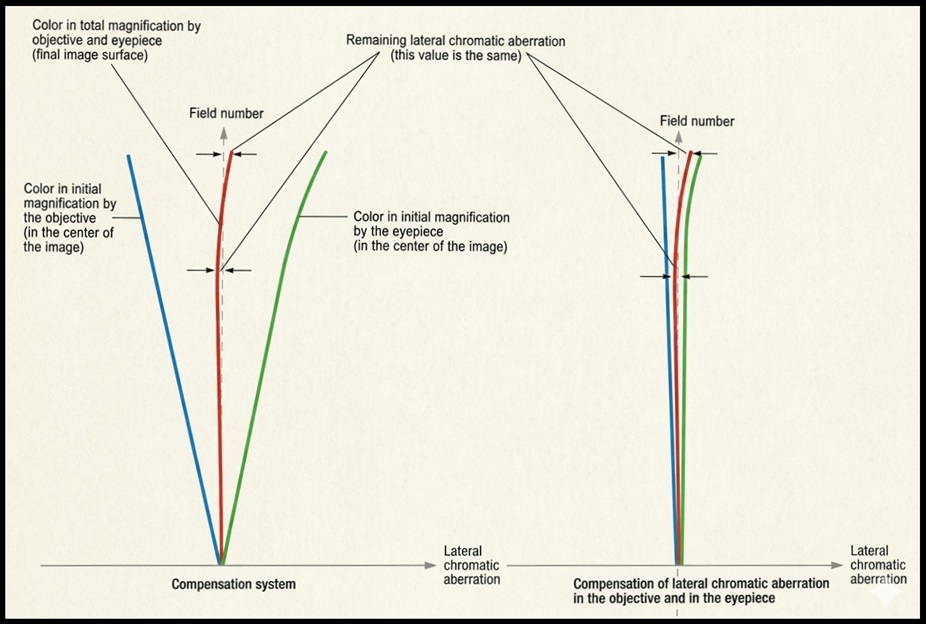
LB optics were designed to be compliant with the existing German DIN standards of the time. These standards specified the optical tube length (160mm), the parfocal distance of the objectives (45mm) and the mounting threads of the objectives (0.7965″ RMS threads), but did not specify how or where the compensation for optical aberrations should be accomplished. Lacking a specification for this, manufacturers were free to define their own standards. Olympus designed the LB optics with partial correction for optical aberrations within the objective lenses and final correction within the eyepieces and/or photo eyepieces (see image below).
Other manufacturers of DIN-compliant microscope optics made their own decisions regarding compensation. Nikon for instance designed their CF (Chromatic-aberration Free) series to include all of the necessary compensation within the objective, while other manufacturers chose to split the compensation in a manner similar, but not identical, to what Olympus used. Because of all of this, objectives from one manufacturer are not generally compatible with eyepieces or photo eyepieces from another manufacturer, whether or not they are DIN compliant.
While the DIN standard succeeded in ensuring that DIN-compliant optics were compatible across DIN-compliant microscope stands, this was only true to the extent that the entire optical systems were cross-compatible. Individual optical elements are not generally cross-compatible and should therefore not be intermixed with optical components from other manufacturers. To guarantee optimal performance of the optical system, you should always make sure that objectives are used with eyepieces and/or photo eyepieces from the same manufacturer and from the optical family. If this rule is not followed, chromatic aberration, significant spherical aberration, and field distortion can result.
Because of the split compensation scheme used by Olympus LB optics, the real intermediate image produced within the BH2 optical tube is unfinished and is therefore not suitable for direct imaging or viewing. This means that the tiny, low-cost eyepiece cameras that drop into the eyepiece tubes should not be used on the BH2, nor should direct projection of the intermediate image onto the camera sensor be employed. Additionally, third party adapters and couplers intended to attach a camera to the scope should not be used, unless their design is such that an LB eyepiece or photo eyepiece is present at the appropriate position within the optical path, and that the camera is at the appropriate position relative to the eyepiece or photo eyepiece.
Field of View of LB Optics
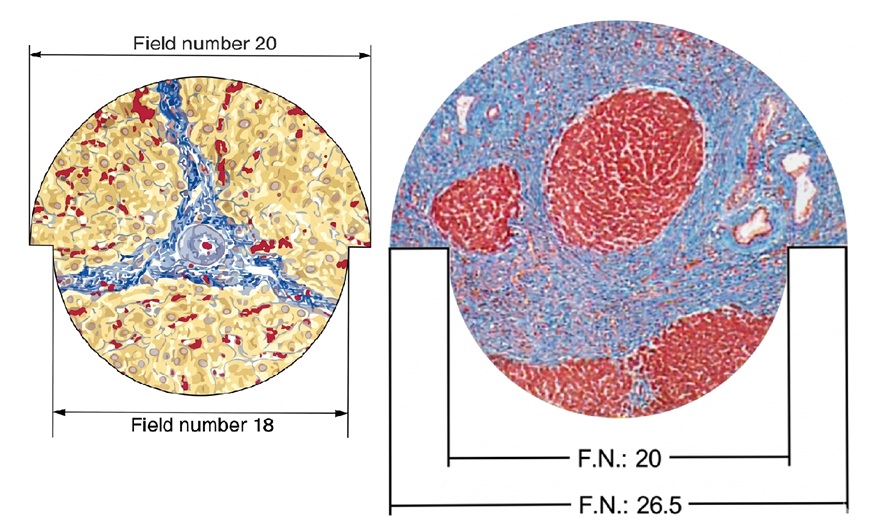
The field of view of the standard BH2 configuration is a circle of 20mm diameter, which is achieved when using either of the BH2-BI30 or BH2-BI45 binocular viewing heads or the BH2-TR30 trinocular viewing head, along with the standard LB 10x widefield eyepieces of 23mm diameter. If you step up to the BH2-SWBI30 binocular viewing head or the BH2 SWTR30 trinocular viewing head, along with the super-widefield 10x eyepieces of 30mm diameter, the field of view increases from 20mm to 26.5mm. Refer to the image below for a comparison of the various fields of view applicable to the BH2. The leftmost image shows the standard 20mm field of view of a BH2, when equipped with 23mm 10x eyepieces, compared to the 18mm field of view found on many lower-cost educational scopes (such as the Olympus CH2). The right-most image shows this same 20mm field of view compared to the 26.5mm field of view that can be obtained on the BH2, when equipped with 30mm 10x eyepieces.
It should be noted that this diagram does not at all do justice to the true viewing experiences; the difference between FN 20 and FN 26.5 is quite stark when looking actually through the eyepieces. The performance of the standard BH2 configuration (Field Number 20 ) is typical of what is found in the many of the mid-market scopes offered today from the various Chinese manufacturers. Do yourself a favor and do not purchase a scope with a field of view of less than 20mm.
It should be noted that the super-wide (FN 26.5) viewfield provided by the BH2-SWTR30 trinocular head only applies to the eyepieces. The BH2-SWTR30 does not provide expanded field coverage for an attached camera.