 Phase Contrast Condensers
The first thing you’ll need is a substage condenser for your BH2 which is compatible with phase contrast. At the very low end, you can use the basic BH2-CD Abbe condenser which is most likely on your scope now, as long as you can find the necessary phase contrast inserts for the BH2-CD (these are rare). To switch from brightfield to phase contrast, the phase contrast insert matching the specific objective you wish to use must be pressed up into the bottom bore of the BH2-CD and then the condenser centering must be adjusted to align the phase annulus within the condenser with the phase ring in the objective. Any time you change from one objective to another, or switch back and forth from brightfield to phase contrast, you will be mucking with these inserts and repeating this same alignment setup. Unless you are using phase contrast with just a single objective, this setup makes for a very slow and cumbersome phase contrast experience. Believe me when I say if this is the route you choose, you will find this to be very annoying and you will quickly find yourself avoiding phase contrast.
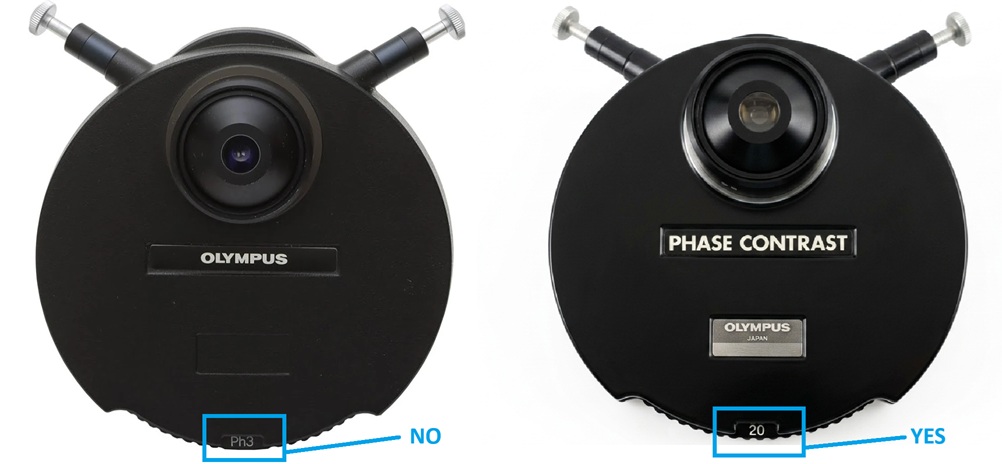
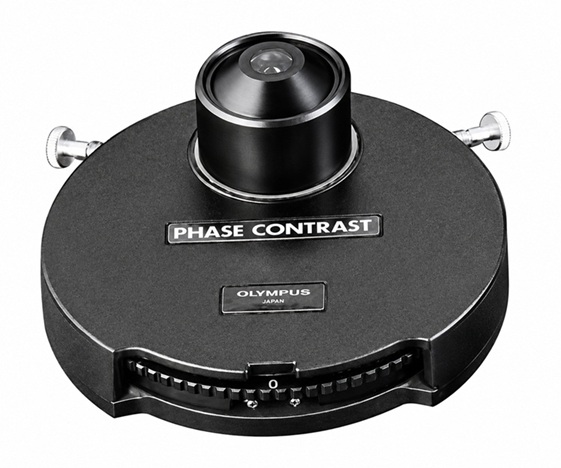
A much better option than the BH2-CD is either of the BH2-PC or BH2-PCD Zernike-style phase contrast condensers. You will get similar performance from these as you would with the BH2-CD solution, since these are all NA 1.25 Abbe condensers. However, compared to the BH2-CD, the BH2-PC and BH2-PCD condensers are a dream to use. Switching from one magnification to another, or back and forth from brightfield to phase contrast, takes almost no effort at all. Just spin the dial on the condenser to select the proper annulus, and that’s it. Plus, you only have to do a one-time setup to center the phase annuli to the various objectives.
What is the difference between the BH2-PC and the BH2-PCD versions? The BH2-PC contains phase annuli suitable for use with 10x, 20x, 40x, and 100x phase contrast objectives, along with a brightfield setting. The BH2-PCD skips the 20X annulus and includes a simple darkfield stop instead. Take my advice and buy yourself a BH2-PC instead of the BH2-PCD. You won’t miss the darkfield stop if you buy the BH2-PC, since there are other ways to implement darkfield, but you will almost certainly miss the 20x annulus if you buy the BH2-PCD. It’s easy enough to add a simple darkfield stop to the BH2-CD condenser, or better still, get yourself a real darkfield condenser if you’re serious about darkfield.
The next step up is a very expensive step. At the high end is either the BH2-UCD universal condenser (assuming you can find the correct BH2-URS10/20/40/100 phase annuli inserts to go with it), or the BH2-NIC Nomarski condenser. Both of these condensers will give similar phase contrast performance, thanks to their NA 1.40 aplanatic / achromatic design, and both will also likely require you to raid your first-born’s college fund for the purchase.
 Phase Contrast Objectives
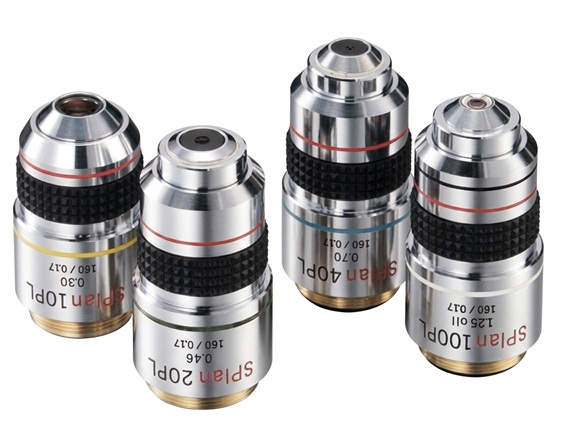
The next thing you’ll need is a set of phase contrast objectives. There were many types of phase contrast LB objectives made for the BH2. Olympus made versions providing PL, PLL, NH, and NM contrasts, but the majority were made in the standard PL variation, as this type is the most suitable for the majority of phase contrast applications. Because of this, PL objectives are the most widely available and the most affordable phase contrast objectives on the used market today.
At the low end were the basic non-plan D achromats (confusingly, D achromats were labeled as “A” on the objective barrel). These were available with phase rings for PL, PLL, NH, or NM contrasts. At the higher end were the SPlan (Super Wide) plan achromats for scopes equipped with super-widefield optics or for those used for photomicrography. SPlans achromats were available with phase rings for either PL or NH contrasts. If you desire plan objectives for phase contrast, the SPlan PL achromatic phase objectives are what you should look for. These objectives have a nice wide 26.5 field number and are a terrific upgrade over the non-plan D objectives.
If you’re just starting out but are pretty sure that microscopy is going to be “the” hobby for you, you can save a significant amount of money in the long run by equipping your scope with SPlan PL phase objectives from the very start. These objectives will provide a very flat visual field which is ideal for photomicrography and will work just fine for both brightfield and darkfield use. While it’s true that there is a theoretical reduction in optical performance when using phase contrast objectives for brightfield or darkfield, as compared to non-phase objectives, in practice this difference is minimal and is imperceptible to most people. Buying SPlan PL phase objectives will cost you significantly more money up front that the non-plan D PL achromats, but will likely save you significant money in the long run. The typical newcomer to the hobby typically buys a scope with basic non-plan achromats, and then, as their interest in the hobby grows, their dissatisfaction with non-plan objectives also grows, and they soon find themselves upgrading to plan objectives. Even further down the road, many will decide to add phase contrast to their arsenal and will therefore be forced to upgrade once again.
 Phase Centering Telescope
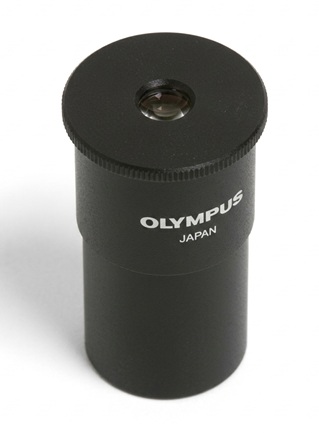
You will also need a phase centering telescope (also called a Bertrand lens). The phase centering telescope lets you observe the back focal plane of the objectives, which allows you to adjust the positioning of the phase annuli within the condenser to superimpose their rings of light with the phase rings within the objectives. This alignment is necessary to obtain optimal phase contrast performance.
Olympus made the CT-5 and CT-30 phase centering telescopes for use with the BH2 (both were labeled “CT”). The CT-5 fits the 23mm ocular tubes of the standard binocular and trinocular viewing heads, while the CT-30 fits the 30mm tubes of the super-wide heads. The CT-30 typically sells for twice the price of a CT-5, but fortunately the CT-30 is not really needed. The 23mm CT-5 can be used in the super-widefield heads if a suitable 23mm to 30mm adapter is used to adapt the fit. Such an adapter can be easily 3D printed if needed.
Another nice thing to know is that if an Olympus phase centering telescope cannot be found, a 23mm phase centering telescope from just about any other manufacturer will work just fine with the BH2. Just be careful that the third-party centering telescope is not too long, or it may reach too far into the ocular tubes and damage the optical prisms within.
 Bandpass Filter
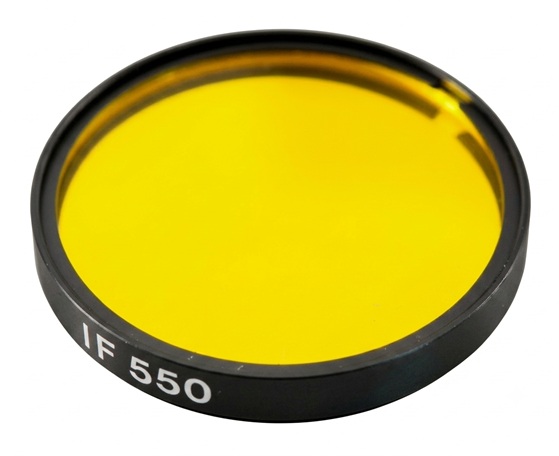
The final thing you will need is a phase contrast filter. A phase contrast filter is a bandpass filter which passes light over the specific frequency band where the phase rings in the objectives were designed to provide maximum phase retardation, and blocks the out-of-band light where phase retardation is poor. Olympus made a 533nm absorptive filter (45G533) for their lower-cost BH2-KPC phase solution (which uses the BH2-CD condenser), and a 550nm interference filter (43-IF550-W45) for the higher-end phase solutions (which use the BH2-PC/PCD or BH2-UDC condensers).
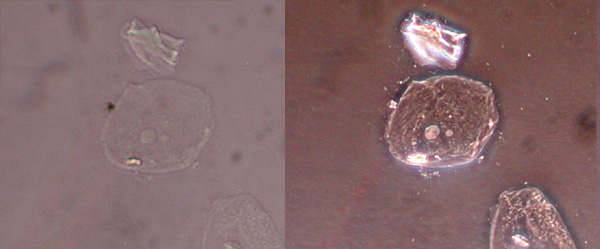
If possible, get the 43-IF550-W45, as its interference design provides significantly better bandpass performance. In practice, most amateur microscopists omit this filter when using phase contrast, since the filter imparts a green monochromatic tint to the resulting images. Go look at a few microscopy videos on YouTube, and you will see that almost none of the amateur phase contrast videos are green. Frits Zernike would of course roll over in his grave if he knew that his phase contrast was misused in such a manner. Zernike understood that for the highest contrast enhancement, the appropriate bandpass filter should always be used, with the resulting images photographed into grayscale to remove the resulting color tint, if desired.
The phase contrast bandpass filter is necessary because phase contrast is a technique that works purely through wave interference, rather than absorptive dyes or stains applied to the specimen, and in order to accomplish this interference, it requires lighting that falls within a narrow band of wavelengths. Like it or not, phase contrast inherently produces monochromatic images, and if you omit the bandpass filter, you will significantly degrade the phase contrast effect.
The fact that many people omit the required bandpass filter is one of the reasons why phase contrast has a poor a reputation for imaging quality among amateur microscopists. To be sure, halo artifacts are a real thing with phase contrast, but why add to this by omitting the bandpass filter?