Purchase a Fully Refurbished BH2 from the Empire of Dirt Workshop
Click here to learn the BH2 options form the Empire of Dirt Workshop.
Click here to learn about the various types of BH2 scopes made by Olympus.
Click here to learn which BH2 is right for you.
Click here to see some real-world eBay stories.
Click here for some more eBay stories.
Click here to see the BH2 Shipping Hall of Shame.
Click here for a dark warning that every prospective microscope owner should read.
This page contains a wealth of information for amateur microscopists who are still in the “tire-kicking” stage of buying a microscope, and who wish to learn more about the Olympus BH2 microscopes. This page also details the types of BH2 equipment typically available from the Empire of Dirt Workshop, in complete, ready-to-go condition.
BH2 Options from the Empire of Dirt Workshop
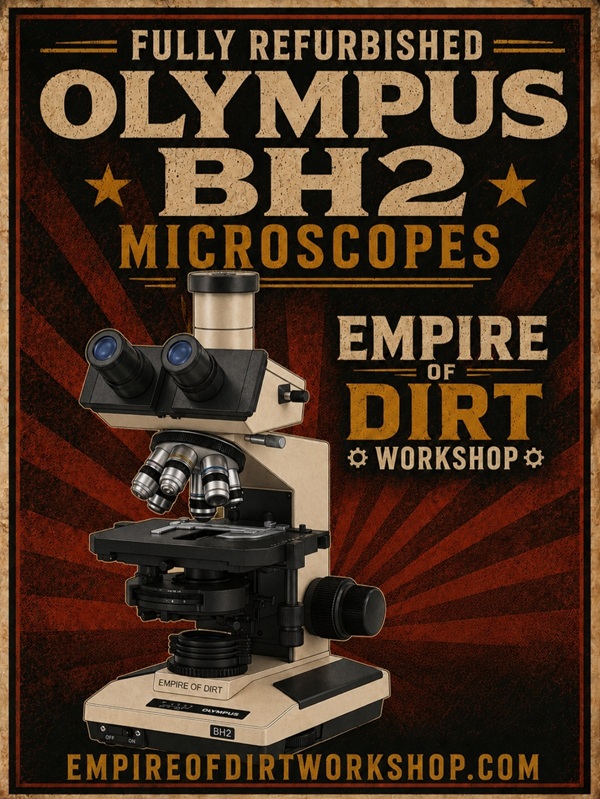
The Empire of Dirt Workshop maintains a large stock of BH2 scopes, basic BH2 accessories, and various BH2 parts. If you are interested in purchasing a newly overhauled BH2 of your own, please contact me (carlh6902@gmail.com). The stock I maintain consists of BHT and BHTU scope stands, stages, condensers, binocular and trinocular viewing heads, and objectives (E, A, and DPlan). The idea is if you wish to get started with a BH2, I can help you get a good scope from which to build upon. Once you get your scope, the sky is the limit as to how far you can equip it. Don’t bother asking for a DIC-equipped scope, or a scope equipped with a full boat of apochromats. These components are far too expensive for me to keep on hand in my little Empire of Dirt. If you are undecided as to which scope to buy, the information below may be helpful.
Upright Microscopes in the BH2 Family
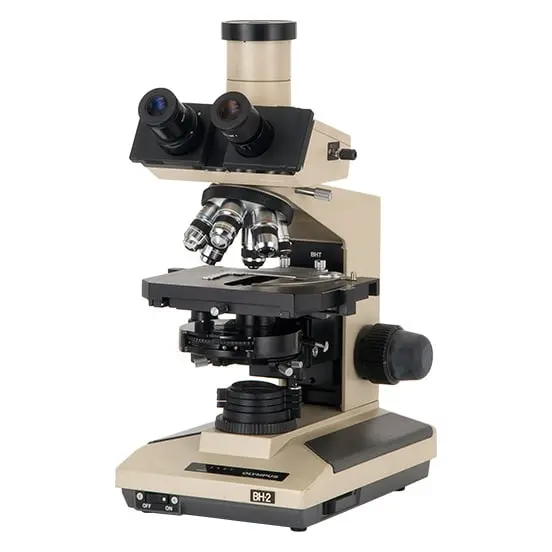
Your choices for microscopes in the Olympus BH2 line are the BHS, BHT, BHSU, and BHTU biological models and the BHSP and BHTP polarizing models. The BHS/BHSP/BHT/BHTP scopes were the first BH2 scopes to be introduced, followed later by the BHSU and BHTU models. In addition to the biological and polarizing versions listed above, there were other models manufactured for specific purposes (such as metallurgical, etc.), but these will not be discussed here.
The BHS microscope was intended to be an all-in-one research scope, designed to satisfy the complex needs of laboratory users for whom a single scope capable of many different operating modes was needed. In contrast, the BHT was targeted primarily for labs and clinical applications and was the primary working scope in many such facilities for a very long time. Both models share the same basic design modularity, with the BHT offering 20W halogen illumination and the BHS offering 100W halogen illumination. These scopes all utilize the same modular nosepiece port, viewing head mount, and stage/condenser mount (with the exception of the BHSP, which has different stage mount, as described below).
The BHSU and BHTU microscopes were introduced some time later, primarily due to competitive pressures in the US markets (hence the “U” in the model names) that could not be adequately satisfied by the BHS and BHT scopes. To address growing North American demand for a scope with a reverse-inclined nosepiece, the modular nosepiece of the BHS/BHT was abandoned in favor of a permanently affixed reverse-inclined nosepiece. Although no longer modular, this nosepiece design answered growing customer demands for greater access to the slide area on the stage, and the BHTU quickly became the dominant scope in US labs and clinics. There were BHTU scopes in a great number of hospitals, clinics, doctors’ offices, and vet clinics in the mid to late 1980s. Curiously, the BHSU was not sold in North America (and seems to have been a product in search of a market, since it did not sell very well anywhere).
The BHSP and BHTP polarizing stands were derived from the BHS and BHT stands, respectively. These versions differ from the biological stands from which they were derived in that they came with a polarizing condenser, rotating/centering circular stage, centering nosepiece turret, and a polarizing intermediate tube, rather than the components supplied with the biological scopes. With the exception of these polarizing components, and the model designations marked above the focus blocks, the microscopes were otherwise identical. The BHSP polarizing scope was supplied with an upgraded rotating/centering circular stage that is not compatible with the modular stages in the family. These other stages can be used with the BHSP, but the BH2-SRP precision stage, with its integrated substage mechanism must be removed from the stand, and replaced with the standard BH2-CH substage used on the other scopes. Once this simple swap has been done, the scope can then use any of the modular stages,
As part of the design change in the BHSU/BHTU variants, an optical assembly was developed which was placed between the nosepiece and the viewing head, to optically compensate for the increase in mechanical tube length that was introduced by the reverse-inclined nosepiece. This optical assembly works by creating a small infinity space within the mechanical tube, bringing the effective optical tube length back to the required 160mm. The presence of this optical assembly imposes a few limitations to the modularity of the BHSU/BHTU scopes that are not present on the BHS/BHT scopes. For most users, these limitations (which are described below) are of little to no consequence.
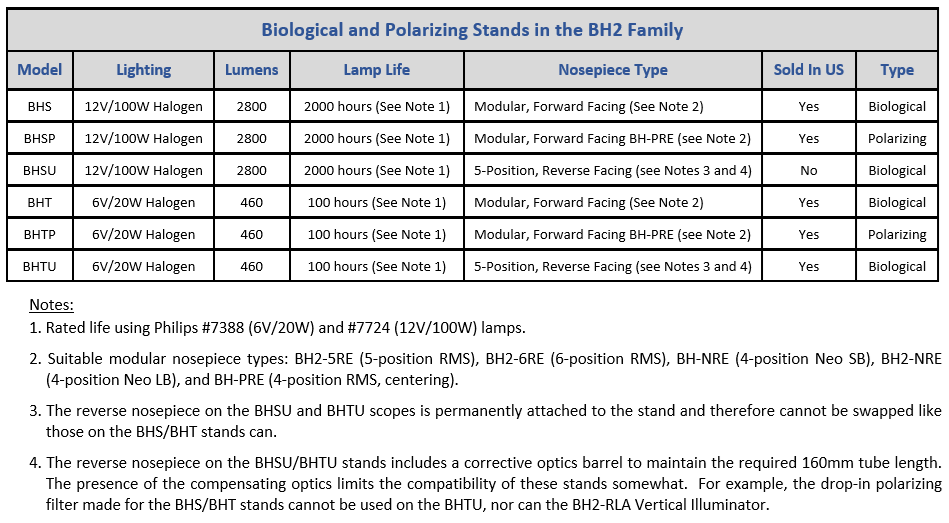
The table below details the differences between the various biological and polarizing stands.
Which BH2 Should I Buy?
So, which scope should you buy? Like many questions in life, the answer is “it all depends.” Specifically, it depends on what you expect from your microscope, and in no small way it also depends on what type of a microscopist you are. If you are buying a BH2 because you want a solid, well-performing clinical microscope on your bench for brightfield, darkfield, Rheinberg, and maybe even phase contrast or polarizing observations, then a BHT or BHTU with its 20W halogen lighting would be a great choice for you. These are nice, full-size scopes which were designed to be put to work and were built to last. The 20W models utilize relatively simple electronics that you can expect to maintain and use for a very long time. If you do not like the idea of a scope with halogen lighting, and would instead rather have an LED-equipped scope, the Empire of Dirt Workshop offers an LED conversion for the BHT and BHTU scopes.
How do the BHT and BHTU scopes differ? The only real difference is in the nosepiece turret. The older BHT design utilizes a front-facing nosepiece, which puts the objective in use at the back, with the unused objectives facing forward, obscuring the operator’s access to the specimen on the stage. In contrast, the BHTU utilizes a more modern, reverse-inclined nosepiece, which puts the objective in use up-front and center, with the other objectives pointing back away from the operator. This arrangement leaves tons of room for the operator to access the specimen on the stage and is therefore the best choice for oil-immersion microscopy, or for that matter for any other techniques where unfettered physical access to the specimen on the stage is needed.
For some, this nosepiece difference in is not a big deal. But for many, the improved ergonomics of the BHTU are a must-have. The relative sales numbers of the BHT and BHTU speak for themselves in this regard. The BHTU, with its improved ergonomics, was generally seen as the more desirable option and therefore handily outsold the BHT in the US market. However, things are a bit flipped now. You should expect to pay more for a BHT in the used market, over a comparably equipped BHTU, simply due to the relative scarcity of BHT scopes.
Another factor to keep in mind is that the reverse-inclined nosepiece of the BHTU, as popular as it was, does come with some minor trade-offs. The nosepiece on the BHTU is permanently affixed to the microscope stand, and to swap objectives you must unscrew and remove the existing objectives, and then screw in the new ones you wish to use. “Like, isn’t that how microscopes work?” Not always. The BHT scope utilizes a modular nosepiece that can be easily removed with the objectives in place and replaced with another nosepiece already loaded with a totally new lineup of objectives. So, if you think you will be swapping out the entire set of objectives frequently (in practice, people almost never do this), then the BHT may be the better choice for you. While you may think that nosepiece modularity is a clear win for the BHT, keep in mind that this second nosepiece with its full boat of premium objectives will cost you far more than you what you would pay for a complete BHTU scope. You should carefully consider whether or not you would ever really use this feature, and weigh this against the greatly improved ergonomics of the BHTU.
An additional factor to consider when making a BHT vs BHTU decision is that, because the physical recess where the viewing head mounts onto the BHTU stand contains an optical lens assembly which is not present on the BHT scopes (this lens assembly was needed to allow the reverse-inclined nosepiece to work on the BH2 stand), a few accessories for the BH2 line are not compatible with the BHTU, since they would physically interfere with this lens assembly. Specifically, there was a small drop-in polarizing filter/analyzer, as well as a brightfield/darkfield vertical illuminator for reflected-light viewing (the BH2-RLA), that won’t fit the BHTU.
The issue with the drop-in polarizer is not a big deal, as there was a BH2-KPA Simple Polarizing Kit offered by Olympus that is a better way to add simple polarizing capabilities to your microscope than the drop-in filter, and this kit is 100% compatible with the BHTU. Failing this, a simple piece of linear polarizing film could be trimmed with scissors to fit within the recess of the BHTU. Don’t let the lack of compatibility with a stupid little polarizing filter dissuade you from the BHTU, if you like the idea of the reverse nosepiece. As for the BH2-RLA brightfield/darkfield vertical illuminator, unless you have a strong interest in metallurgical microscopy (and the vast majority of amateur microscopists do not), you will likely never miss the inability to utilize this on your BHTU stand. And besides, the various brightfield vertical illuminators for the BH2 line can be used on the BHTU.
So, enough about the BHT and BHTU scopes, what about the BHS scope? At first glance, and from a bit of a distance, the BHS looks like a BHT scope. In fact, from the knees up, the two scopes are essentially identical, and they share the same design modularity. It’s below the knees where the crucial differences can be found. Upon closer inspection, you’ll see that the BHS has a much wider base than the BHT/BHTU, and a much larger lamphouse attached to the back. The wider base of the BHS contains beefier electronics, and the larger lamphouse contains the brighter halogen lamp, both of which comprise the 100W halogen lighting. It’s no stretch to say that when a BHS is turned up to 11 (you had to know there would be a Spinal Tap reference in here someplace, right?), there is enough sheer light intensity to all but obliterate the retinas of any who may innocently peek into the eyepieces. It is as bright as the sun, and to many of the extreme microscope freaks in the crowd, that’s just perfect!
But practically speaking, for the majority of users and for the majority of applications, the 20W of a BHT or BHTU is absolutely fine. For the rest there is the BHS. To be fair, there are legitimate reasons for a microscope to utilize 100W halogen lighting, but most amateur microscopists on a finite budget will never require this level of lighting intensity. When new, BHS scopes sold for quite a bit more than the BHT and BHTU scopes, and this still holds true for their pricing on the used market. BHS scopes have a much larger footprint on the bench, generate far more heat, and utilize more complicated electronics (for which replacement parts can be difficult to find). For these reasons, I don’t usually recommend a BHS scope for most new users. Why waste the additional money and sacrifice all that desk space for a scope that will make you pay through the nose when the electronics require servicing or replacement, and which offers little in tangible benefits in exchange?
I should briefly mention the BHSU here. This scope is essentially a BHS scope with the non-modular, reverse-inclined nosepiece of a BHTU. The BHSU was never sold in North America and doesn’t seem to have sold very well elsewhere (although there may be a few on the Island of Misfit Toys). Jokes aside, there are a few BHSU scopes out there, but they are quite rare. If you’re hellbent on having such a scope, it is a simple manner to make your own from a BHS stand and a BHTU stand. You start out with a BHS stand and a BHTU and end up with what is essentially a BHSU stand and a BHT stand.
So, having discussed the advantages and disadvantages of the various models, it’s now time to look at what type of a microscopist you are. To most people, a microscope is a tool that allows them to look at the microscopic world, and so long as their microscope performs this function well, they will be happy with their microscope. At the other end of the spectrum are people to whom the microscope is a wonder of mechanical engineering and a thing of beauty, and the hardware itself is their primary source of satisfaction, not the things that they can do with their scopes. For these people, observing the microscopic world is just a small part of their enjoyment of the hobby. These people tend to be extreme gadget freaks who want all of the high-dollar, top-of-the-line hardware that they can get their hands on. They will collect all the various bits and bobs that were made for their scopes and are always on a quest to upgrade. Money is of course no object. They might spend more on a single apochromatic objective than the average hobbyist has invested in their entire system. They likely have several different microscopes (OK, let’s be honest, they have a LOT of microscopes) from the various manufacturers.
A Dark Warning
I feel the need to warn you about something. I wouldn’t feel right if I didn’t. Like a drunken bender in Las Vegas, the microscope hobby can be quite addicting to some people. It starts simple enough. Just a microscope and a few boxes of slides sitting on a desk somewhere. That soon grows until it becomes a room full of microscopes, which the owner justifies as a “collection”. This continues until even the “collector” is left wondering how in the world this all happened. They eventually find themselves waiting until their spouse is away from the house before bringing in their latest scopes, because “it’s just easier that way”. This is not a pretty picture I’m trying to paint. Those who are truly afflicted may even set up a dedicated microscope workshop in their basement. And maybe they’ll make a website dedicated to their favorite microscope, and perhaps even a YouTube channel. These people are easy to spot. They’re the ones looking around, nervously avoiding eye contact right now. For these people, a simple BHT or BHTU would never be sufficient. Don’t get me wrong, they will have these in their collection, but they will also have countless other scopes from various manufacturers in their line-up. Don’t ask me how I know this, but for these people, there is no such thing as enough and there is no cure for what they’ve got!
Note: The photo below is an AI creation. No human psyches were harmed in the production of this image!